January 8, 2023

1943. The "British Ally" Newspaper in the Soviet Union

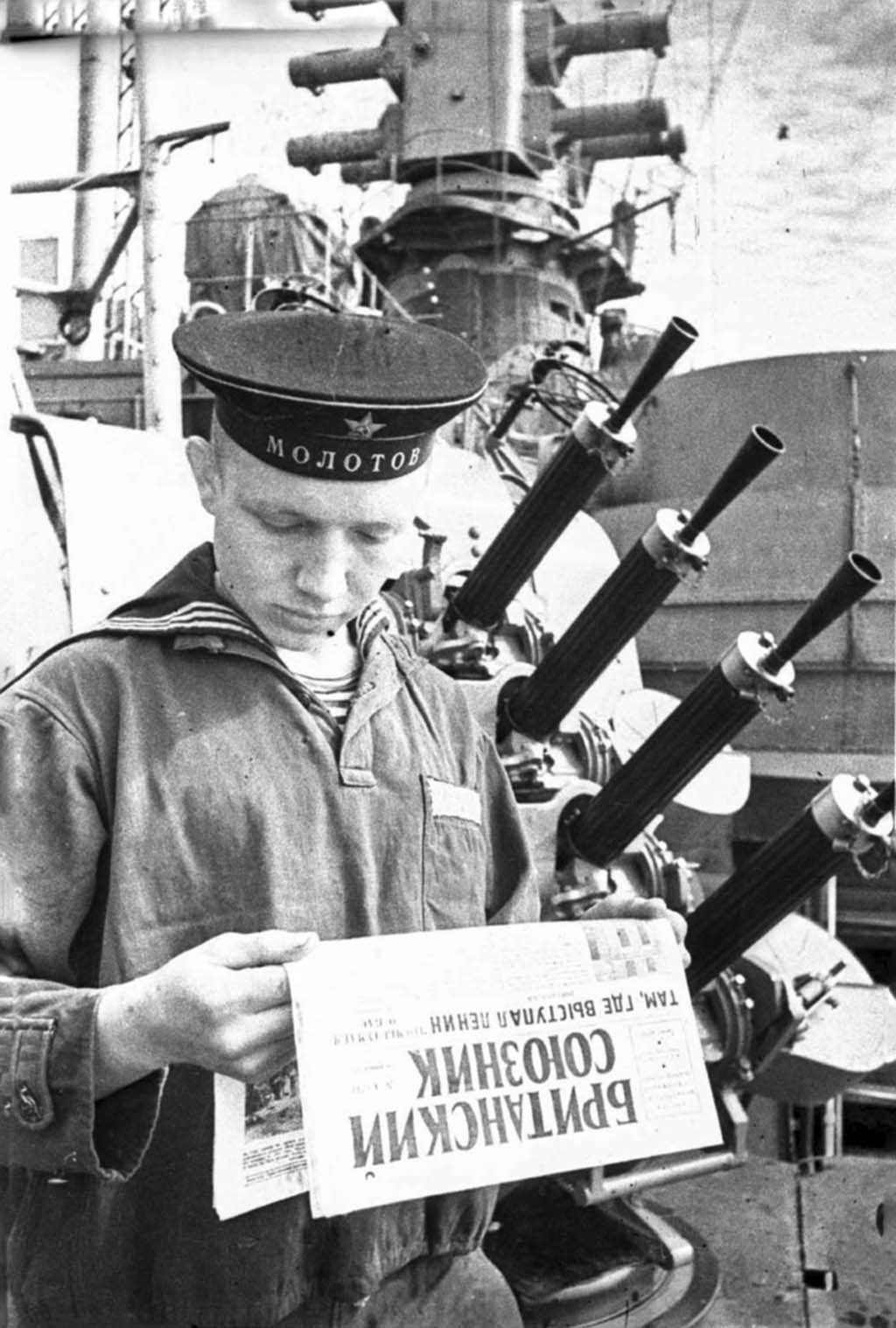
British Ally
"Sailor of the Soviet cruiser of the Black Sea Fleet project 26-bis 'Molotov' I. Chertov reads the newspaper 'British Ally'" (Photo by Yevgeny Khaldeisource)

From Newsweek, August 9, 1943, pp. 79-80:

Britansky Soyuznik

We are behind the British in selling America to Russia. Bill Downs, Newsweek and CBS correspondent in Moscow, gives some journalistic reasons why:

"Why don't you Americans do something similar?"

Increasingly, Russian military and government officials toss this question at correspondents in Moscow. With the query, they usually pass a copy of an eight-page, picture-crammed tabloid that is telling the story of Great Britain to Russians from Stalin down to the lowliest Red Army private.

Britansky Soyuznik (British Ally) is the only publication sponsored by a foreign government in Russia.* It was started shortly after twenty Britons, all assigned to public relations, arrived in Moscow six months ago. Its original circulation was 20,000, but Moscow relaxed paper restrictions to permit a 5,000 increase. About half the circulation goes on public sale at a ruble a copy; 9,000 go to subscribers paying 52 rubles a year; and the remainder to a free list that includes, besides Stalin, all high government officials and army generals. Libraries, provincial newspapers, leading journalists, film and radio committees, and foreign embassies also are on the circulation list. The political section of the army takes thousands of copies for distribution to troops and front-line newspapers.

The staff of Britansky Soyuznik says it could easily distribute three times the paper's circulation. So great is the demand that copies are passed from hand to hand and sometimes are resold for as much as 80 rubles apiece. They swiftly vanish from the newsstands of Moscow and Kuibyshev.

The paper is subject to the Russian censorship but has little difficulty. It shuns political ideology and sticks strictly to features and photos of British troops in action and factory workers, farmers, and production on the home front. Canada, Australia, New Zealand, South Africa, India, and the rest of the empire are represented also. The bulk of Soyuznik's material comes via the Soviet Relations Division of the Ministry of Information in London. The tabloid is plugged on the Soviet radio, in Pravda, Izvestia, and other Russian newspapers.

Soyuznik is only part of the British public-relations job. The group also distributes pamphlets on the British war effort, English books to libraries and troops, and photos to the Soviet press. Last month, a special film attaché arrived to handle the exchange of all types of movies. Negotiations are under way for a radio tie-up.

By contrast, the United States has only one public-relations man assigned to Russia. He is Comdr. John Young, former publicity head of the New York World's Fair, who now is in the United States. He was brought to Moscow by Ambassador William H. Standley early this year.

⎯⎯⎯⎯⎯⎯⎯⎯⎯⎯⎯⎯⎯⎯⎯⎯⎯⎯⎯⎯⎯⎯⎯⎯⎯⎯⎯⎯

*Although Washington has no plans for an American counterpart of Soyuznik, the OWI is negotiating for an outpost in Moscow. It hopes to get one by autumn.

January 7, 2023

1944. The 256th Volksgrenadier Division

The Volksgrenadier
Volksgrenadier soldiers in the Ardennes in 1944 (source)
From Newsweek, November 20, 1944, p. 38:

The Bottom of the Barrel

Bill Downs, war correspondent for Newsweek and the Columbia Broadcasting System, sent the following account of how the products of Hitler's barrel-scraping conscription decrees are fighting.

Volksgrenadier was the name Hitler gave to the new units which were formed out of remnants of his defeated armies, plus new recruits and transferred personnel from other branches of service. The first of these formations encountered by the Allies was the 256th Division. The British ran up against it in the Hertogenbosch area in October.

Rag, Tag, Bobtail: According to prisoners, the division originally was the 256th Infantry Division which served in Russia but was so decimated in the fighting last June that survivors were returned to the Wehrmacht reserve for re-forming. The division was reconstituted on Sept. 8 as a Volksgrenadier unit. One-quarter of its members were veteran survivors of the old division. Another quarter came from replacement battalions stationed in Saxony. Another group came as draft from the German Navy. The remainder were old men and youngsters brought into the army under the Nazis' latest manpower orders.

The division was given a few months' training and then dispatched to man what then was a quiet sector around Tilburg. The luckless Volksgrenadier unit arrived just in time to run into the British offensive to clean up Southern Holland. They were mowed down. But even these inexperienced soldiers fought well and died bravely. The British found one man of about 50 who, though critically wounded, refused medical treatment and during the last half hour of his life constantly tried to reach for a clip of cartridges for his tommy gun in order to continue fighting

These Volksgrenadier units are being made to feel they are "Minute Men" defending their county. Many of them say it is not a question of being for or against Hitler—it is a question of Germany. That is how they are going into battle. As evidence of how seriously they are taking the war a captured document shows one platoon on daily 17-hour basic duty.

January 6, 2023

1953. Eleanor Roosevelt on Liberalism and American Foreign Policy

An Interview With Eleanor Roosevelt

Longines Chronoscope
CBS

August 26, 1953 - 11:00 PM

EDWARD P. MORGAN: Mrs. Roosevelt, some nights ago I had dinner with a man and his wife in Spokane, Washington. Quite sincerely, but quite seriously, they asked me two questions. They said, "Do these foreigners hate us as much as they seem to?" and "Are they ever going to be grateful for the things that we do for them?" Now, you've just come back from one of your latest trips in far parts of the world. Could you answer those questions?

ELEANOR ROOSEVELT: Well, I would not say that foreigners hated us. I would say that many of them were a little suspicious; that they did not like to feel that everything they wanted to do—they had to ask us for our help. Or some of it would come from the United Nations, and they liked that better because they were members and they felt they got it by right and there was no one individual nation that they had to depend on. But I would say that it was always hard to be grateful for something which you felt. You would like to be able to do without asking anyone.

BILL DOWNS: Well, Mrs. Roosevelt, we've heard a lot about criticism of American policy and what we have done or tried to. Is this something new or, I mean, is this something to do with this administration, the Truman administration, or perhaps even your late husband's administration?

ROOSEVELT: I think it began probably when the war was over and we began to have to help people to build up again, and we were the ones who had not been bombed and who had no homes destroyed. We had difficulty in getting new homes, but we didn't have to carry away acres of rubble of old homes that once existed. And we had our whole production unit intact, and practically no other nation in the world was in that fortunate position.

DOWNS: In other words, this is history rather than policy.

ROOSEVELT: This is history rather than politics, and I think, of course, that there is some envy in it—there is when people say, "Will they never be grateful for what we've done?" I think there is gratitude.
But gratitude is sometimes swamped by the sense of "why was this done?" Was it done in the long run so we could—we who just freed ourselves from political domination—be dominated through economics? Now, that's not unnatural, because the history of most of these countries in Asia and some in parts of Europe is that people who do things for you expect something in return.

MORGAN: And I suppose if we do things as we are supposed to do, in enlightened self-interest, that we are not necessarily expected to anticipate gratitude?

ROOSEVELT: Well, of course it is enlightened self-interest, because getting them back on their feet is necessary for us because we need markets.

MORGAN: You spoke of the United Nations, Mrs. Roosevelt, and that brings up a most topical point. And before we get into the heart of it, let's explore public reaction to it here. There seems to be a great deal of suspicion among our own people about the United Nations and its effectiveness. What is your reaction to that?

ROOSEVELT: Well, I think that's easily explained, because you see that we're a very big country and a very strong country. We have not needed any of the programs carried on by the specialized agencies which are the action part of the United Nations. We've not needed those programs in our country because we were alright. India has needed to have land cleared of malaria. Other nations have needed help to get rid of tuberculosis.
There are a thousand and one things that less fortunate nations can see have happened and be grateful for from the United Nations. We don't happen to have been in that category. It matters to us what the United Nations does elsewhere because, again, where people are ridden with malaria they will never buy our goods.

DOWNS: Well, Mrs. Roosevelt, do you think that the United Nations as an instrument of world political opinion and operation has lost ground in the last say, five, six years in this country?

ROOSEVELT: I think, like everything else, that we started out expecting that the United Nations would solve every difficulty right just by being the United Nations. We didn't realize that the United Nations was only all the nations gathered in one place, but all the troubles remained just as they were before! And therefore we had to work to make the United Nations work, and we didn't want to work, and we didn't expect to have to do this work. And now we know we have to. Which is healthy, I think.

MORGAN: That brings up another point, Mrs. Roosevelt. Secretary of State Dulles has just made an important speech before the American Bar Association in Boston, the essence of which was that the United Nations Charter, I think he put it, was a pre-Atomic Age charter, and therefore not flexible to the times. And he recommended that the Security Council be stripped of the veto. And said that in some future assembly—in '55, I believe it was—that the United States would consider sponsoring such a move. What do you believe about that?

ROOSEVELT: Well of course that's a great change for the United States because we felt that, unless we had the veto, we would never get the charter through Congress, and that was one reason why the veto was put there.
Of course, the fact that the Soviets have misused the veto; used it for a great many things that it was not intended for. What it was intended for was to make it possible for a nation, a great nation, to prevent the discussion of domestic affairs which they considered were no business of anybody else's in the world. Whether we now are ready to submit to discussion of our domestic affairs is a question that the people will have to decide.

DOWNS: Aren't we in effect—or isn't Secretary Dulles in effect—asking for a showdown, though, when he says "Alright, leave us; split the United Nations, or let people line up on our side or their side with no veto, and we carry this by majority vote." Do you think that is a possible consequence?

ROOSEVELT: Well, I would hope that perhaps just as we trust our people in the United States, we were trying the experiment of trusting the nations of the world. I hope we would do nothing, however, so definite that we really hurt the United Nations, because I think this is the one great hope for eventually building peace. And to do anything like making a pronouncement of a policy which you cannot change if you find it is unwise in the future—and today heaven knows you're being met constantly with new reasons, and you ought to be able to be flexible.

MORGAN: Mrs. Roosevelt, excuse me. Speaking as Bill Downs did a moment ago of lining up on one side or the other—what is your view as to our position regarding India and the issue of her representation at the Korean Peace Conference?

ROOSEVELT: Well, last year I was in India and I wrote a book called India and the Awakening East as just trying to explain some of the problems of that area of the world in very simple fashion because I could only give impressions. It's not a learned treatise.
My feeling is that when you insist on lining up people, what you do is put our friends with the Soviets if you insist that that's the only place they can sit. I feel it's very unfortunate.

DOWNS: Well, Mrs. Roosevelt, you have become known as the leader of what is loosely called the "liberal movement" in this country, or what used to be called the liberal movement in this country, and some people call them "do-gooders" and the rest of it. Could you define a liberal for us, I mean, in your own words?

ROOSEVELT: It's very hard to put in a few words what a liberal is, but I would feel that a liberal was a person who kept an open mind, was willing to meet new questions with new solutions, and felt that you could move forward; you didn't have to always look backwards and be afraid of moving forward. 

MORGAN: And that's what this National Issues Committee that you're...

ROOSEVELT: The National Issues Committee is going to try to look at the issues, to put them in simple terms so that the people can understand them as objectively as possible and to feel that they can, as the liberals do, move forward.

MORGAN: Now for the final question, Mrs. Roosevelt. I'm sorry, Bill.
We've been told by our experts that we may have to live in this world of uncertainty and indecision short of war, in a Cold War for x number of years to come. What is your recipe for us to face up to it?

ROOSEVELT: Well, I think the study of our history. Certainly the people who settled this country didn't have any great security, and it's hard for the young to live in uncertainty. They love to be sure of the future. But I really think that we have the stamina, particularly if we look at what we came from, to live through uncertainty.

MORGAN: Thank you very much.

January 4, 2023

1953. "Edward R. Murrow of CBS: 'Diplomat, Poet, Preacher'"

Newsweek Profile of Edward R. Murrow
Newsweek cover featuring Edward R. Murrow, March 9, 1953 (source)
From Newsweek, March 9, 1953, pp. 40-44:

Edward R. Murrow of CBS: 'Diplomat, Poet, Preacher'

Back in 1948, when saloons that needed clientele were the TV-set manufacturers' best customers, television seers had already announced that a newscaster on radio would soon be obsolete. Television could show the news. These industrial forecasters turned out to be quite as wrong as the political pollsters of that year.

No other medium can touch TV when it comes to describing arranged sight events (political conventions, ball games, dog shows, et al.). But television has not replaced radio in up-to-the-minute, comprehensive news reporting. It is not likely to. A TV commentator can, of course, talk into a camera about the latest news flash. But this is radio news that happens to be on a screen; it is not television news, which by definition requires a picture of the event. Radio can almost always keep higher on top of unpredictable incidents (one definition of one kind of news) than can TV. And, compared to television, which has to pay for mobile units and then stop and add up its time charges and film and cable costs, radio as a news dispenser is quite cheap.

Formula: Du Mont, the smallest American TV network, has never seriously tried to present real news. ABC-TV, always a news-conscious network, attempted to program four and a half hours a week on an $8,000 budget. No go. NBC-TV, with more money and more facilities than any of its rivals, has John Cameron Swayze. As one newspaperman put it: "All NBC needs is Ed Murrow." He was referring, of course, to See It Now, the weekly half-hour TV show on CBS, and, of course, to Edward R. Murrow, the man who narrates it and helps plan it.

Edward Roscoe Murrow (see cover) and his co-producer, Fred Friendly, have devised a formula for TV news that seems to many to be so far unbeatable. After their first show in the fall of '51, Friendly claimed that "we just look good by default." They still do. Long before the premiére, Murrow had come to the conclusion that "there is one thing TV can do—take people places where they're unlikely to get," and See It Now spends no time on studio conversations. Murrow and Friendly make no attempt to handle anything like all the news of the week, or even all the high lights. They choose, instead, to concentrate on a few subjects in their half hour, and, sometimes, to accent the peripheral rather than the main action. Their Eisenhower Inauguration coverage showed street cleaners going to work after the parade and Republicans hunting their cars after the balls were over. Their cameramen are instructed to stick, as far as possible, to close-ups. And the people in the close-ups are supposed to have something to say. The news ideas for the weekly show come from Murrow and Friendly, their crews, their assistants, and their friends. The show has won a Peabody Award and more intelligent and continuing viewers than anybody could shake a really accurate TV yardstick at.

Staff: Few of See It Now's standards could be upheld without a large, active, and talented staff. Four camera crews, each with a photographer and a sound man, work full time for the show. Two reporters, Joe Wershba and Ed Scott, help hold down the news front. All CBS correspondents everywhere are available, and extra footage from News of the Day comes in every week. These people and their equipment cost money. As Murrow puts it: "In this lousy business it costs 500 bucks to take the cover lens off the camera." The sponsor, the Aluminum Co. of America, which can almost always dig up $500, provides some $20,000 a week for the show. CBS has to make up a difference "too often." When Murrow, six other reporters, and twelve camera crews went to Korea to prepare the unforgettable “This Is Korea—Christmas 1952," Alcoa provided an extra $65,000, and CBS anted up $15,000. The network may not be delighted with the financial aspect of See It Now, but, characteristically, it knows a prestige show when it owns one.

An added attraction is the relationship between Murrow and the sponsor. The board of Alcoa bought See It Now after one lunch with Murrow and without seeing an audition film. President I.W. Wilson went farther: He wanted Murrow to report if he objected to any commercial, and he wanted Murrow to delete commercials if the show warranted the time. "I was still curious," Murrow says, "as to what would happen the first time we threw it out. Nothing happened."

Since then, he has dropped it four times—probably creating no bad will for Alcoa. When See It Now presented a report on iron ore (tantamount to Dorothy Collins singing "Be Happy, Go Lucky" on the Camel News Caravan), Murrow never heard a word from Alcoa. On March 8, on their own, Murrow and Friendly are going to produce a commercial for Alcoa free of charge.

Murrow has the same luck with his radio bankroller. The American Oil Co., which sponsors his nightly newscast over most of the country (the Hamm Brewing Co. picks it up in ten Western states), has never objected to Murrow's eliminating Amoco commercials in the interest of the news—something he has done on numerous occasions.

Voice: Murrow, a slim and tall (6 foot 1), dark-haired man with a furrowed brow, is now 44. Christened Egbert Roscoe, near Greensboro, N.C., he moved to Skagit County, Wash., when he was six. His parents still live there, and one of his brothers, Dewey, is a successful contractor in Spokane. His other brother, Lacey, is a brigadier general in the Air Force. Egbert was a chubby, round-faced kid with the biggest voice in Skagit County. He used to tell Dewey that he got the fewest spankings because his neighborhood-wide hollering embarrassed the household. Murrow's latter-day colleague Eric Sevareid called it cold when he said: "Murrow was born to broadcast."

Murrow's first public speech was an unscheduled one at a PTA meeting. Each mother was to make a brief comment on a current problem, and when the chairman called on Mrs. Murrow, little Egbert jumped to his feet to report that he and his brothers had trapped a rabbit the day before and sold it on the way home. The address is said to have made a great success.

The Murrow family was not rich. The senior Murrow, a farmer in Greensboro, became a railroad engineer for a logging company in the state of Washington. Egbert took a year off after high school to earn money to go to college by working in the woods on a survey gang. After his freshman year at Washington State College, he shifted scenery in the school auditorium and served as houseboy at the Kappa Delta sorority house. He was serious-minded, seldom dated, and didn't care for athletics, although he played a little golf. Ed Lehan, now a Spokane attorney, who roomed with Murrow for the four college years, says that "he had a photographic mind. He could sit through classes all week and never take a note, but on Friday nights he could rattle off the professors' lectures almost verbatim."

Egbert changed his name to Edward after his sophomore year, became president of the junior class, and was student-body president as a senior. He was the top cadet in the ROTC, noted for his firm and effective parade-ground voice. He also was the best debater on the campus and the No. 1 man in dramatics. His voice caught the fancy of a little crippled WSC speech teacher named Ida Lou Anderson, who made him her protégé and perhaps did more to perfect his vocal delivery than any other person. When, during the blitz, Murrow was abroad for CBS and broadcast This Is London, Miss Anderson caught every program. Murrow asked her to cable him collect each week with criticisms. She occasionally had some, but always sent them air mail. Miss Anderson, who died during the war, suggested that he put more emphasis on the subsequently sonorous "This." Murrow's present "This is the news" is not only his unregistered trademark but practically antiphonal.

Murrow was 22 when he received his Phi Beta Kappa key and his B.A. in history and speech—his only earned degree (he now has five honorary doctorates). He then became president of the National Student Federation in New York at $25 a week, and made two trips abroad to study. Two years later, he was made assistant director of the Institute of International Education.

Talks: In 1935, Edward Klauber, the executive vice president of CBS and a former New York Times man, hired Murrow as director of talks and education. Klauber, whom Wells Church, now head of CBS radio news, calls "the godfather of the whole damn radio-news business," sent Murrow to London as director of foreign talks. CBS being without any other men abroad, Murrow, with a secretary and an office boy, was the European bureau. He and radio were so unimportant that "I couldn't even go to an American press club meeting, let alone be a member." (He was elected president in 1945.)

At first Murrow merely arranged for important people to speak and set up cultural programs. Then, to combat NBC's more extensive coverage (two men), he hired William L. Shirer. (The CBS staff today is knee-deep in Murrow men; he has since hired Wells Church, Eric Sevareid, Larry LeSueur, Charles Collingwood, Dick Hottelet, Bill Downs, Howard K. Smith, Charlie Shaw, and Cecil Brown.) When Hitler moved into Austria and the authorities refused to let Shirer speak on the air from there, Murrow flew from Berlin to Vienna in a chartered plane, rode a streetcar into town, received permission, and delivered his first news broadcast. Except for one brief period after the war, when he served as vice president in charge of news and public affairs, he has not stopped since. Now a member of the CBS board of directors, Murrow's first love is broadcasting. He has "no mind for budgets, no heart for firing people."

News: Murrow's broadcasts from London during and after the blitz made a great score in the world of the radio-news business. So did his broadcasts, after the United States entered the second world war, from North Africa and Europe. He got to know his top boss, William S. Paley, in wartime London. Paley recalls: "His entrée was just fantastic, and he was full of inside information. Everybody had a genuine respect for him, and they would come clean with him. It seemed he was almost the most important American there."

Since 1945, Murrow, the boy who was born to broadcast, has continued his radio program, except for his short tenure as vice president. He and a staff of five (Jesse Zousmer, his news editor; John Aaron, his researcher; and three girls) turn out a show that is heard by 1,750,000 radio listeners every night. See It Now, according to the Nielsen rating, is seen as well as heard in almost three million homes each week. (When Walter Winchell first went on ABC-TV, his rating was nearly double Murrow's, but he is now below Murrow.)

Features: In addition, Murrow has narrated the three "I Can Hear It Now" albums which Fred Friendly compiled, and introduces This I Believe, the daily five-minute radio program that features prominent people explaining their philosophies. Murrow wrote the introduction to the best-selling book (more than 200,000 copies sold) of the same name that Simon & Schuster published. He conducts the annual CBS year-end show on both radio and television. Last week he was also busy planning a new television program, a live-interview show featuring Murrow talking to newsmaking people throughout America.

Murrow, his handsome wife, Janet, whom he calls Köchin (German for cook), and their 7-year-old son, Charles Casey, live most of the time in a large Park Avenue apartment. Since Casey entered the first grade, he has stopped joining his father on his annual Christmas broadcast. They spend part of each week end at their "log cabin," an eight-room house on a hill near Pawling, N.Y., where Murrow cuts brush, hunts, fishes, and plays golf (sometimes with neighbor Lowell Thomas).

Casey, it is said, was in favor of General Eisenhower in the last Presidential campaign. Who was his father for? Who, indeed, is CBS for politically? Two fifths of his mail accused him of being pro-Ike. Three fifths of his mail called him pro-Stevenson. Murrow's answer to the total criticism of his broadcast content: "Nobody can be wholly impartial, but you must discount prejudice and not reach a conclusion unless you try to trace the facts that led you to it." Murrow is also accused of being gloomy, portentous, and even pompous by some of his most severe viewers and listeners.

Not severe is Fred Friendly, a burly, loose-jointed dynamo of a man who deserves more credit for See It Now than he gets. "I don't kid myself. Even what I do myself, I do in his [Murrow's] name. I can move mountains through him and with him. Whatever Wershba or Scott or I do, we try to live up to Murrow" Friendly, whom Murrow describes as "the only man I know who can take off without warming his motors," was left in New York at Christmastime to cut the 77,000 feet of Korean film down to 6,000. "When I was editing it, I found that my decisions were unconsciously his. With all my exuberance and vitality, I'm coming to understate like him. He's a big spirit; you can't help being dominated."

A civil-defense executive who asked Murrow to narrate an information film explained that he had picked Murrow because there are three voices in the United States that people really listen to—Bishop Sheen's, Arthur Godfrey's, and Ed Murrow's.

Murrow's colleague, Eric Sevareid, wrote of him in "Not So Wild a Dream" in 1946: "He is a complex of strong, simple faiths and refined, sophisticated intellectual processes—poet and preacher, sensitive artist and hard-bitten, poker-playing diplomat . . . He could absorb and reflect the thought and emotions of day laborers, airplane pilots, or Cabinet ministers . . ."

Paley, boss of Murrow as well as of CBS, certainly is satisfied: "Murrow measures up as a broadcaster, a writer, and as a thinker—especially as a thinker—as well as any man I know. He hides, on the job, his own personal feeling, and never takes advantage of his privileged position except maybe from time to time and then unconsciously."

And so, curiously, it is said, is Sen. Joseph R. McCarthy satisfied. He is quoted as observing that he wished every radio and TV commentator were as fair as Ed Murrow.

Murrow may have everything.