September 15, 2022

1944. Entering Caen After the Allied Bombing and Liberation

"Why Did You Bomb Us?"
"A British soldier carries a little girl through the devastation of Caen, 10 July 1944" (source)

Below are brief accounts from Bill Downs and war correspondent Al Newman, both of whom entered Caen shortly after Allied forces took the city. More reports from Downs in July 1944 are featured here. From Newsweek, July 24, 1944, pp. 29-31:

Why Did You Bomb Us?

Bill Downs, Newsweek and CBS correspondent, was among the first few reporters to enter Caen after the British captured it. He cabled the following eyewitness story of the broken city, which once had 50,000 inhabitants.

A British colonel poked his head into a trench and said: "So you want to go into Caen?" We poked our heads out of the trench, looked at each other, and said with some doubt: "Yes."

"Well, go ahead," the colonel said. "But at your own risk." Continuing that kind of talk is bad for morale so we climbed into our jeep and headed for a mile of highway under German shell and mortar fire. No one liked the idea too much, but we had been waiting four hours to go ahead.

The jeep picked up speed. After the first quarter of a mile we relaxed—a little.

Down the hill was Caen proper. We came to an area which had received part of the 2,000 tons of bombs dropped by the RAF two days before. It looked as if someone had picked up the whole area, dropped it, and then come along with a gigantic finger and poked holes in the ground. White limestone dust covered everything, even the leaves still remaining on the shattered trees. Someone might have played a bad joke with dirt whitewash. We walked down the hill past the ruins of houses with their curtains flapping lifelessly from shattered windows. Parked beside a filling station with three leaning pumps was the remainder of a car. It looked like an oversize pepper shaker, there were so many holes in it.

This street once had been the beautiful approach to Caen. Ancient trees lined both sides of the avenue. In peacetime it was called the "Rue de la Délivrande."

The following day we were able to drive in from the west. There it was the same old story of destruction on the outskirts with damage tapering off as you reached the center of the city.

All Caen civilians who wish are being evacuated to camps near the beaches. Many of them since the invasion have lived in the Lycée Malherbe, the boys' school in the center of the city run by priests of the Church of St. Etienne. For weeks families slept on straw on the floor. There was no water, no light. But the Germans respected the asylum of the church and didn't bother the people. All in all, about 6,000 stayed here.

It was a different story for those who chose to live in their homes. German restrictions tightened when the Allies invaded. Then, following the big RAF bombing, SS troops ran wild through the town, beating civilians, breaking into stores and homes, and taking what they wanted. Liquor was their first demand.

What Price Deliverance: The people cannot understand the reason for this terrific bombing that preceded the final attack. "We waited four years for you to come," they say. "Then two days before you liberated us you bombed us." There has been no count of civilian casualties from this raid but preliminary estimates say that they may reach 2,000, maybe more.

The military argument for this tremendous attack is that the day after it was made the Germans began pulling men and equipment out of the Caen defenses. How many Germans would have defended the city and whether it would have been fought for house by house are questions that cannot be answered now. Many correspondents here have taken the line that such bombing is actually unnecessary, harmful to the Allied cause, and militarily useless. My belief is that it is impossible to tell in the case of Caen. The fact remains that Caen has been liberated.

•

Another Newsweek correspondent, Al Newman, arrived in Caen on Bastille Day, four days after Downs' visit. Newman sent this contrasting description of the town:

Before the cathedral, the Place du Lycée boiled with people. It took no second glance to tell that this wasn't a Bastille Day celebration but a panicky, tearful throng of refugees waiting for trucks to carry them to Bayeux. The dimly lit nave of the cathedral was thickly spread with straw, and hundreds, looking grim, scared and hopeless, lay there.

In the adjacent Lycée Malherbe, where more refugees huddled, relief workers buzzed from group to group. There were French Wacs brought from England for just such emergencies and local civilian Red Cross workers. American civil affairs officers answered questions, took notes, and shepherded refugees into trucks, saw to meals and supervised burial of the dead in mass graves behind the Lycée.

That was Caen's Quatorze Juillet observance.

September 11, 2022

1943. Soviet Summer Offensive Repels German Forces

"Guns, Tanks, and Chopin: A Look at the Russian Front"
Soviet anti-tank riflemen during the Battle of Kursk, July 20, 1943 (Photo by Natalia Bode – source)

From Newsweek, August 23, 1943, p. 28:

Guns, Tanks, and Chopin: A Look at the Russian Front

Bill Downs, Moscow correspondent for Newsweek and CBS, was among the group of reporters taken to the Orel front last week. Since the Russians seldom allow correspondents—or any other foreigners—near the front lines, the following eyewitness account by Downs is one of the first to be published on the present fighting in the Soviet.

Lt. Gen. Peotr Peotrovich Sabennikoff, 6 feet 4 inches tall and only 49 years old, stood in the tent of his field headquarters last Thursday and told us some amazing things about the Russian summer offensive. Suave of manner, with an almost wistful blond mustache, the general was often forced to interrupt his talk by the noise of groups of bombers and fighters speeding to the front, only a ten-minute flight away. Here are the main points he made:

Machines: The Soviet Command prepared the Orel breakthrough with the heaviest artillery and mortar barrage in history. "Compared with 90 guns per kilometer at Verdun," said Sabennikoff, "the Red Army had desyatki more barrels." The word desyatki means "tens." This is the closest Russian word to the English "dozens." It meant that the Russians had concentrated more than 1,900 barrels per kilometer around Orel. Note that the general specified "barrels," not guns—multibarreled weapons permit an exceedingly heavy mobile concentration.

Sabennikoff said the artillery opened up paths of attack 6 to 8 kilometers deep in the German lines, although in some instances the artillery and mortar preparation extended 30 to 40 kilometers from the front. The general declined permission for correspondents to see one of these battlefields. "There are mines all over the place," explained Sabennikoff. "I don't have sappers available yet to clean them up. I wouldn't risk a walk over such battlefields."

Sabennikoff said that American and British tanks were used in this offensive—British Churchills, American Grants. He praised the speed of both tanks but said the Grants were too high and were hit frequently. "Our tank men still like the Russian 34 best," he said. The foreign tanks were mixed in with the Russian tank groups, so there was no opportunity to weigh them as separate tactical units operating independently.

Concerning the defeated German forces, the general knocked down the flood of reports from the front that the Nazi "summer Fritz" or "total Fritz" (inferior type of soldier) was being used in large numbers on this front. He said the German command had concentrated crack troops on the central front for the summer offensive: "I have seen plenty of them. Very few are over 30. Most are well-trained, tough men in their 20s."

However, he said there were indications of cracks in Nazi morale shortly after the Russian offensive began: "We had been watching the Germans for a long time. When they finally struck against Kursk, it was just what we wanted. We began a concentric offensive on July 12. Our attack forced them to dissolve their reserves which were badly placed in relation to our attacks. Then I noticed that men began to surrender. At no time did this happen in great numbers—but the fact that it happened at all is indicative. The Germans I talked to said that the fall of Mussolini had a great effect on them. However, we captured an order telling the German soldier to stay in his trench and resist to the last bullet. Most Nazis are doing that."

Sabennikoff knows what he is talking about. He is a representative of the Supreme Command, and commanded the army group at Orel which first entered the city from the east. He was the first general in the town. Now he is chief of the Orel garrison from which this dispatch is written, only 25 miles from the front lines.

Scorched Earth: We reached the general's headquarters after fourteen hours of a backside-slapping ride from Moscow which gave all the correspondents a spanked-baby feeling and engendered a great personal hatred for the Lend-Lease ¾-ton Dodge trucks officially known as "bucket-seat ammunition carriers." They are sturdy and made the trip without a growl from the gear box, but it was like trying to break in a mustang with a wooden saddle. Sabennikoff's headquarters in the valley of the Oka River are camouflaged in a group of trees. The correspondents slept four to a super-comfortable tent with a Red Army girl as orderly. Ours was a youngster named Dora who had been in the army since 1941.

I have seen scorched earth in other sectors of the Russian battle front, but nowhere is the destruction so complete and so calculated as that now being carried out by the Germans as they are pushed back toward Bryansk. Every village is literally razed to the ground. All brick and stone buildings, whether important or not, are blown up. Wooden houses are burned.

Everywhere were trenches, foxholes, pillboxes, and gun emplacements. Along the main Mtsensk highway there were few signs of fighting. However, you could tell no man's land by the fact that for several kilometers there would be absolutely nothing but field on field of weeds. But up to the Russian lines the fields were cultivated—yellow with ripening wheat, rye, and oats.

Accordion: The most impressive moment of the trip came after midnight one night when I stood on a height above the Oka River. The moon was just rising. To the east in the distance, Orel lay quietly as if resting from its ordeal, but to the west on the horizon there was suggestion of light from the fires of burning Russian villages. A rocket slowly curved skyward in the distance—it seemed to climb barely half an inch into the horizon. Then from the darkness came the roar, the full-throated roar of hundreds of bombers from Soviet airfields somewhere in the rear. They made more noise in the next ten minutes than anything I had ever heard before. It was a steady throbbing that literally shook the ground. The Russians like to bomb from low heights where they can see the target. A sentry with a tommy gun standing nearby looked at me and grinned, stopped a minute, and then walked on.

Down in the men's barracks nearby the roar of the planes was followed by some tuning up on an accordion. Over Orel in the distance there came a big shuddering boom—another delayed-action mine going off. The accordion began playing a Chopin waltz. The sentry came back and grinned again.

September 9, 2022

1943. "Russian Orthodoxy's Offensive"

The Orthodox Church in Wartime Russia
"1943 meeting of the Bishops' Council of the Russian Orthodox Church" (source)
From Newsweek, December 27, 1943, p. 70:

Russian Orthodoxy's Offensive

One of the most remarkable occurrences of the war has been the Soviet Government's growing leniency not only toward religion as such, but specifically toward its onetime archenemy, the Russian Orthodox Church. For the developments on Christmas, Bill Downs, Newsweek and CBS Moscow correspondent, has sent the following dispatch.

Two significant events in the spiritual life of the Soviet Union occurred last week. Yemelyan Yaroslavksi, former leader of the anti-religious movement and a faithful old-time Bolshevik, died. The press made no reference to his atheism; others referred to his "scientific writings." Long lines of people filed through the while marble Hall of Columns in downtown Moscow to pay homage to one of the most popular Communists of Russia—a man, who represented the tenacity of the religious feeling he could never quite stamp out. On Dec. 6, Yaroslavski's ashes were buried in the Kremlin wall behind Lenin's tomb.

The other event was the announcement in the newly founded Journal of the Orthodox Church and Moscow Patriarchy that a system of religious schools would be established throughout the Soviet Union in order to train priests and clerics to carry on the Orthodox religion. This is proof of the Soviet Government's sincerity and good faith in giving the official go-ahead which resulted in the episcopal assembly of the Russian Orthodox Church in Moscow last September. That was when the Metropolitan Sergius was elected Patriarch of Moscow and all Russia.

From the historical point of view, there is nothing hypocritical or devious in this shift of attitude toward the Orthodox Church. Briefly, the situation is this: Before the revolution, the church was one of the wealthiest institutions in Russia. Its corruption was notorious, and its subservience to the czarist government—which employed the church as a weapon—made it an enemy to the revolutionaries, who were also inspired by the atheistic concepts of Marxism. Hence the Soviet Government included most church land and property in its declaration of common ownership. the official attitude was that the church, with its ritual and dogma, must not have a chance—either by interference or tradition—to act as a brake on the progressive drive of the new Soviet Government.

Sergius the Patient: Thus the Orthodox Church, while never completely obliterated, went into a decline. But the wise leaders like Sergius (who retired to a Volga village near Kuibyshev and continued to preach the faith) accepted the complete break of church and state. They knew that the old-time Russians are one of the most deeply religious people on earth—people who would keep their beliefs.

The patience and good judgment of these men were rewarded when war came. Their church began to grow as one of the spiritual forces of the Soviet Union's fight against Fascism, since church leaders have left no doubt which side their God is supporting.

Thus the Orthodox Church takes the offensive. To faithful churchgoers, working and sowing to keep the Red Army in the field, the resurgence of their religion is another indication of the justice of their cause and God's. And although the Orthodox Church now emerging will be maintained only on the basis of a complete separation of church and state, the movement now under way is more than a temporary wartime arrangement. The establishment of ecclesiastical schools is indicative of this.

• The program of religious studies will follow that of the formed seminaries. That means it will constitute one of the most rigorous courses in the world. Students will get such things as the history of the Christian and Russian churches, Christian apologetics, canonic rights and the Constitution of the U.S.S.R., hymnology, the reading of Greek texts and the history of Catholic, Protestant, and Anglican churches.

• Studies will be free. Moreover, money will be provided for those who need support and dormitories for students living out of town. Also, no candidate will be accepted until he is 18, which means that men entering the priesthood will first have a Soviet education.

• The study period is reduced from a prewar six or seven years to two or three years. (The course at the highest school in the land, the Orthodox Ecclesiastical Institute in Moscow, will take three years; at secondary schools in the dioceses, two years.)

August 29, 2022

1952. "McCarthy Cries Again"

Collier's Magazine on Senator McCarthy's Attacks on the Press
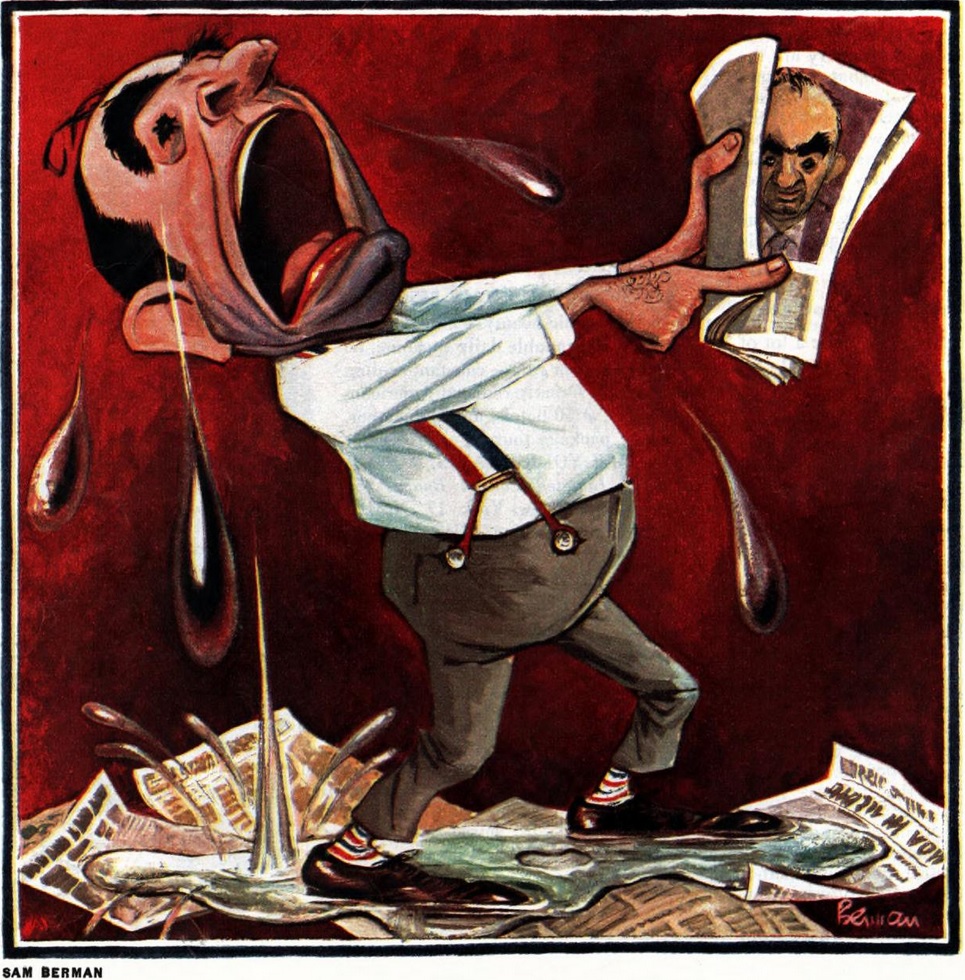
Cartoon by Sam Berman in Collier's, August 2, 1952
Editorial from Collier's, August 2, 1952:

McCarthy Cries Again

A couple of years ago Senator Joe McCarthy buckled on his armor and, like a twentieth-century Don Quixote, set out to slay the dragon of American Communism single-handed. His intentions seemed noble as those of the good night. But also like the good knight, who attacked a procession of monks and a flock of sheep under the impression that they were brigands and ogres, he got a little confused about the targets of his sallies.

Thus it has come to pass, as his crusade continues, that anyone who takes issue with him assumes the look of the Red dragon itself. Disagreement becomes lies and crookedness. An adverse editorial comment is automatically a "left-wing smear." And the senator charges treason against a countryman as recklessly as Don Quixote charged the windmill.

Mr. McCarthy has had a busy time of it, because there are a great many people who approve the purpose of his crusade, but object strongly to his methods. There are many publications which feel the same way. One of them is Collier's. Another is Time. And we at Collier's feel just a little discriminated against because, so far, the senator has ignored us while singling out Time and accusing it of "twisting and distorting the facts about my (McCarthy's) fight to expose and remove Communists from government."

This charge apparently grew out of a Time cover story on Senator McCarthy. The senator had earlier attacked it as a "vicious and malicious lie." But recently he employed a new tactic which was definitely not cricket.

Backed by the prestige of his office, he sent a letter to "practically all Time advertisers," according to his own statement, which, while it did not come right out and ask them to take their business elsewhere, suggested that they were doing their country a disservice by their continued support of the magazine.

Since some of these advertisers were "not aware of the facts," the letter stated, they were "unknowingly helping to pollute and poison the waterholes of information." Still swimming along in his aquatic metaphor, the senator said that "it is much more important to expose a liar, a crook or a traitor who is able to poison the streams of information flowing into a vast number of American homes than to expose an equally vicious crook, liar or traitor who has no magazine or newspaper outlet for his poison."

The source of the senator's "facts" were an article from the American Mercury and a reprint from the Congressional Record. On the basis of these, the gentleman who complains about distortions and smears virtually accused Time's editors of dishonesty and treason in so many words.

Naturally Mr. McCarthy anticipated some criticism. "I realize," he said, "that bringing these facts to the attention of Time's advertisers will cause some of the unthinking to shout that this is endangering 'freedom of the press." But, he added, "To allow a liar to hide behind the cry 'You are endangering freedom of the press' is not only ridiculous, it is dangerous."

To this we can only answer that when a man hides behind the cry "You are a liar" before anyone has accused him of endangering freedom of the press, he must be feeling rather insecure. And when he tries to intimidate a critical publication by seeking to alienate its chief sources of revenue, he is something less than courageous.

Senator McCarthy has set himself up as the final authority on loyalty and Americanism. He insists that his accusations are not to be doubted, and his judgment is not to be questioned. Yet, a few weeks after he wrote his letter to Time’s advertisers, he testified in Syracuse, New York, that the Washington Post and the New York (Communist) Daily Worker "parallel each other quite closely in editorials." And when he was asked whether he would consider the Christian Science Monitor a "left-wing smear paper," he replied, "I can't answer yes or no."

Those are the statements of a man who is either woefully unperceptive or wholly irresponsible. And when such a man asks that his wild-swinging attacks be accepted without question, he is, to borrow his own words, not only ridiculous but dangerous.

We are not concerned that, on the basis of this editorial, the senator may now add us to his company of "left-wing smearers," or that he may also warn our advertisers of the danger of supporting another publication which pollutes the waterholes of information. What does concern us is the real danger of Communist infiltration in government, and the fact that this danger is too serious to be obscured and clouded by Senator McCarthy's eccentricities, exaggerations and absurdities.